


From large language models to multimodal large models, AI has long been accustomed to roaming freely through the digital world—it can write articles, generate images, and answer questions, yet it remains separated by a screen and knows nothing about how the real physical world works.
Physical AI is precisely what is needed to break down this barrier—to bring AI truly into the real world, let it understand the nature of matter and grasp the laws of physics, and complete the full “perceive–reason–act–feedback” loop in real-world settings. In this intelligence revolution, one question is crucial: how can physical AI “see” the physical world?
The answer lies in hyperspectral technology.
Physical AI: bringing intelligence from screens into the physical world
To understand the deep connection between hyperspectral imaging and physical AI, we first need to clarify: what exactly is physical AI?
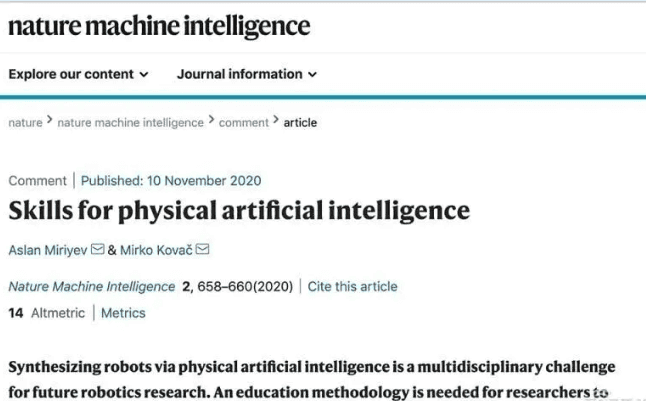
Physical AI is not a concept invented out of thin air. Back in 2020, scientists from the Swiss Federal Laboratories for Materials Science and Technology and Imperial College London formally introduced the term in Nature Machine Intelligence. Now, with increased investment from tech giants such as NVIDIA, physical AI is moving from the academic frontier to the center of industry.

Traditional AI and physical AI process text, images, and speech and understand gravity, friction, materials, chemical reactions, and O3C reactions.
Simply put, traditional AI is the "sage of the digital world": it processes digital information such as text, images, and speech, but knows nothing about physical laws such as gravity, friction, material properties, or chemical reactions. Physical AI, by contrast, aims to enable artificial intelligence to understand and follow physical laws, deeply integrating data-driven learning approaches with the physical constraints of the real world.
A complete physical AI system necessarily includes five core capabilities:
· Physical sensing: collects real-world material and spatial information through multimodal sensors
· Physical reasoning: causal reasoning grounded in physical laws rather than mere pattern matching
· World modeling: build simulatable, predictable models of the physical world
· Embodied execution: performing actions in real environments through physical devices
· Closed-loop feedback: gather feedback from physical interaction and continuously evolve
Perception is the starting point for everything. Without precise, deep perception of the physical world, reasoning and action become water without a source.
Hyperspectral imaging is the most groundbreaking "eye for matter" in the physical AI perception system.
Hyperspectral: the visual limits of physical AI
Human eyes can only perceive light in three wavelength bands—red, green, and blue—and conventional RGB cameras are no different. When we see an apple, we know it is red and round, but we cannot tell whether it has mold inside, cannot determine its sugar content, and certainly cannot identify its variety or chemical composition.
Hyperspectral technology breaks through this visual limit.
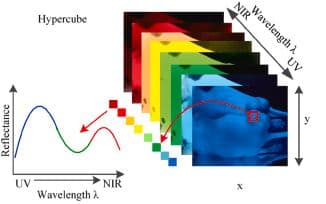
Hyperspectral imaging splits light into dozens or even hundreds of contiguous narrow bands, extending from visible light into the near-infrared and even mid-infrared region. Each pixel corresponds to a complete spectral curve—and that curve is the material's "chemical fingerprint."
Different molecular structures absorb and reflect light at specific wavelengths, creating a unique spectral signature. Healthy tissue differs from diseased tissue, fresh nuts from moldy ones, pure metals from alloys — even a change in the water content of a single leaf produces a measurable difference in its spectral curve.
This is exactly the core value of hyperspectral for physical AI:
01
From "appearance recognition" to "essence perception"
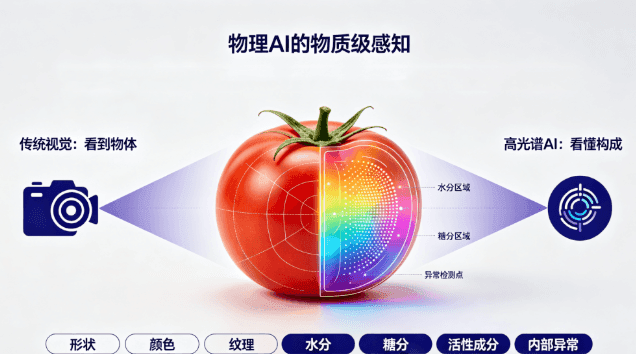
Traditional vision AI can only recognize surface features such as an object's shape, color, and texture, while hyperspectral imaging gives physical AI perception at the material level. AI no longer just “sees an object”—it can “understand what it is made of.”
02
From "pattern matching" to "physical interpretability"
Deep learning is often criticized as a “black box”—it can make a judgment but cannot explain why. Hyperspectral data, by contrast, carries clear physical meaning: every absorption peak corresponds to a specific chemical bond vibration, and every spectral curve obeys the physical laws of optical reflection and absorption.
This fits naturally with physical AI's "data-driven + physics-constrained" technical approach, turning learning from blind pattern fitting into precise reasoning guided by physical laws.
03
From "static recognition" to "dynamic closed loop"
The combination of hyperspectral imaging and physical AI goes beyond detection and recognition. When AI can perceive changes in the intrinsic properties of matter, it can go further and predict how physical processes will evolve—for example, the distribution of fat and moisture in meat, fatigue damage in materials, and the progress of chemical reactions.
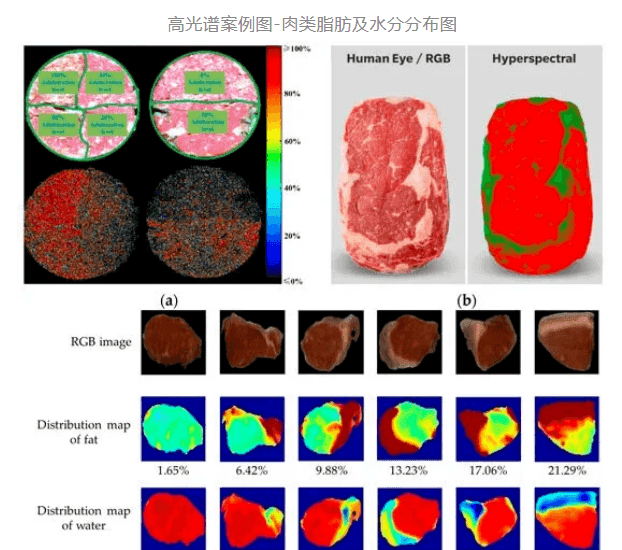
Hyperspectral example image: fat and moisture distribution in meat
This enables physical AI to achieve a true closed loop—perceive, predict, intervene, and feed back—transforming it from a passive detection tool into an active control system.
This sensing capability, which gets to the essence of matter, has long been proven in industrial settings. Now, with breakthroughs in chip miniaturization, it is moving out of the factory and into the wider consumer world.
SPECU: building full-stack capabilities for hyperspectral physical AI
As a leader in the commercial deployment of hyperspectral technology in China, SPECU is already at the forefront of combining "hyperspectral + physical AI".

Co-founded by scientists from top universities such as Imperial College London, MIT, and Cambridge, together with senior engineers from a global leader in visual sensing, this technology company has followed a dual hardware-and-algorithm technology strategy since its founding—and this is precisely the core path for deploying physical AI.
Chip-level full-stack hardware
A sensing foundation spanning industrial and consumer
The perception capabilities of physical AI ultimately depend on the physical limits of hardware. SPECU is one of the few companies worldwide with end-to-end capabilities in developing, manufacturing, and using its own hyperspectral chips.
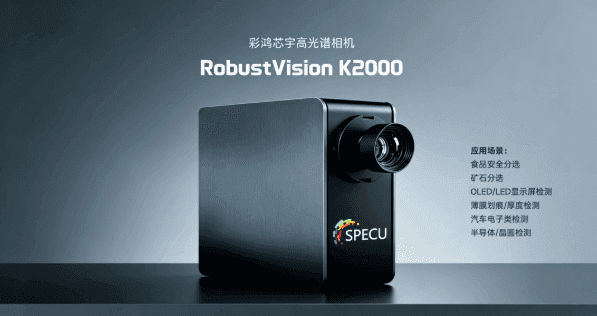
For industrial applications, the company offers a complete product portfolio ranging from precision optical modules to the industrial-grade hyperspectral camera RobustVision K2000. The system's spatial resolution is up to 15–20 times that of comparable products, providing high-quality, multidimensional raw data for physical AI algorithms.
Targeting the consumer market, the team also overcame miniaturization bottlenecks and introduced a chip-scale miniature hyperspectral module with a volume of just a few cubic centimeters. While maintaining spectral resolution and detection accuracy, it achieves extreme reductions in power consumption and size, can be highly integrated into smartphones, wearables, smart home devices, service robots, and other terminals, and lays the hardware foundation for physical AI to enter everyday life.
Physics-driven algorithms let AI understand the essence of spectra
Rather than taking the off-the-shelf approach common to general-purpose AI algorithms, SPECU's algorithm team started from the first principles of spectral physics to build a physics AI engine optimized for hyperspectral applications.
· Physics-informed neural network (PINN): embeds physical laws such as the Beer-Lambert law and spectral mixing models into the network architecture, significantly reducing reliance on labeled data while improving model interpretability and generalization;
· Spectral self-supervised pretraining: pretrain on massive unlabeled spectral data so AI can learn the spectral feature patterns of substances on its own, then fine-tune for specific industry scenarios;
· Lightweight edge deployment: Tailored to the different compute capabilities of industrial production lines and consumer devices, algorithm models are highly compressed and optimized to enable a real-time closed loop of "collect and analyze."
Real-world deployment: from industrial production lines to everyday settings
The value of physical AI ultimately has to be validated in real-world scenarios. SPECU's hyperspectral physical AI solution has established end-to-end coverage, from large-scale industrial commercialization to exploration of consumer scenarios.
Food industry: large-scale commercial deployment achieved
As the most mature application area for hyperspectral technology, the food industry is a core deployment area for SPECU's hyperspectral physical AI.

The company's intelligent inspection solution, built on hyperspectral imaging and physics-based AI, is now successfully deployed in the food industry across nut sorting, fruit and vegetable grading, and grain and edible oil quality inspection, among other applications. On nut processing lines, a single channel of the crawler-type hyperspectral intelligent equipment can process thousands of items per second, identifying early internal mold, insect damage, and differences in active components without shelling, with sorting accuracy above 99%. It significantly replaces manual visual inspection and helps food companies improve quality control standards and reduce loss costs. In fruit and vegetable sorting, the system can simultaneously detect multiple intrinsic quality indicators, including sugar content, acidity, moisture, and internal browning, enabling quality-based grading and supporting standardized distribution of agricultural products.
From surface defects to intrinsic quality, and from sample inspection to checking every item, hyperspectral physical AI is redefining quality control standards in the food industry.
Consumer scenarios: opening up inclusive possibilities for physical AI
As miniature hyperspectral modules mature, physical AI perception is moving out of factories and into the daily lives of ordinary people.
When a phone integrates a hyperspectral module, you can pick up a tomato at a farmers' market and take a photo to learn its freshness, pesticide residue level, sweetness, and moisture content in real time—choosing produce no longer depends only on experience and feel. When red rashes or pimples appear on the skin, a quick photo can use spectral features to distinguish hives, chickenpox, bacterial infections, and other problem types, providing a reliable reference for health assessment.
When a home service robot is equipped with hyperspectral vision, it can overcome the blind spots of conventional vision: salt, sugar, and MSG have similar granular forms, while light soy sauce, dark soy sauce, and vinegar are very similar in color. They are easily confused under an RGB camera, but to hyperspectral physical AI they have distinctly different material “fingerprints” and can be accurately identified and distinguished.

This upgrade in the dimension of perception brings a fundamental leap in segmentation accuracy across the physical world: conventional machine vision can only perform “surface-level partitioning” of the world by color, shape, and texture, whereas hyperspectral physical AI can perform “intrinsic segmentation” by material composition and chemical properties, enabling machines to truly understand the internal differences of each object and achieve finer-grained, more realistic understanding of the physical world.
Beyond detection: what future is physical AI opening up?
As hyperspectral imaging gives physical AI an eye that can "see through matter," a cognitive revolution in machine vision is reshaping both industrial production and everyday life.

In industrial settings—from food processing and semiconductor manufacturing to renewable energy quality inspection and pharmaceutical production—hyperspectral physical AI is turning “sample-based inspection” into “100% inspection of every item” and “post-hoc troubleshooting” into “real-time prediction.” It is driving manufacturing upgrades toward higher precision and lower waste.
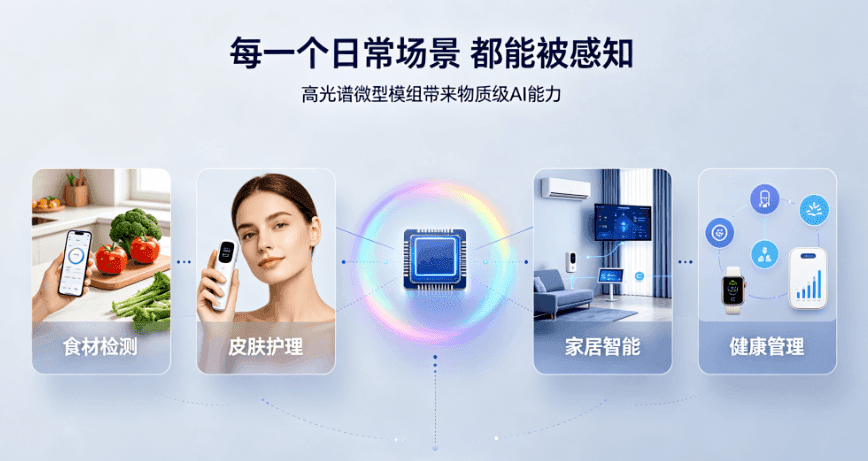
In the consumer space, the spread of hyperspectral micro-modules will make physical AI a capability within everyone's reach. From food inspection to skin care, from smart homes to health management, material-level perception will extend into every everyday scenario, enabling smart devices to truly understand the physical world rather than only the digital information on their screens.
More importantly, hyperspectral physical AI is breaking the industry's "high precision means high cost" curse. As chip-level technology matures and reaches mass production, hyperspectral imaging is moving from a precision instrument in the lab to a standard fixture on industrial production lines, entering more industries and everyday settings.
SPECU has always believed that the ultimate form of machine vision is not just "seeing clearly" but "understanding"—understanding the essence of matter, the laws of physics, and the underlying logic of how the world works.
The wave of physical AI has arrived, and hyperspectral is its sharpest visual blade.
When machines can perceive spectral dimensions beyond human vision, and when AI learns to reason about the world through the laws of physics, we are redefining how machines see the world.
About SPECU
Wuxi SPECU Technology Co., Ltd. (SPECU) focuses on the research and development of hyperspectral visual perception hardware, AI algorithm engines, and the implementation of industry-specific intelligent equipment solutions. Guided by its technical philosophy of “giving machines multimodal perception beyond vision,” the company is committed to reshaping how machine vision interacts with the world through hyperspectral technology.
For more information about hyperspectral and physical AI solutions, follow our WeChat official account or contact us.