

First generation: RGB solves “seeing.”
Second generation: hyperspectral addresses “understanding matter.”
Third generation: photonic sensing and sensing-computing integration address “popularization.”
Ultimately, hyperspectral imaging is expected to evolve from today's specialized vision into the general-purpose intelligent sensing platform of the future.
What AI really needs is not just more data,
but rather higher-value data.
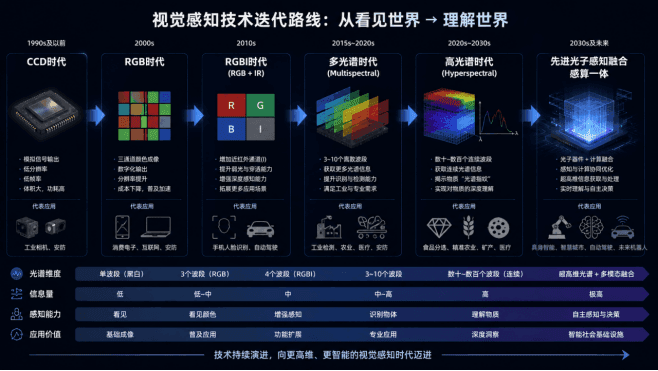
Figure 1. Evolution path of visual perception technology: from CCD and RGB to hyperspectral and photonic sensing-computing integration
AI is getting smarter, so why does it still not "understand" the world?
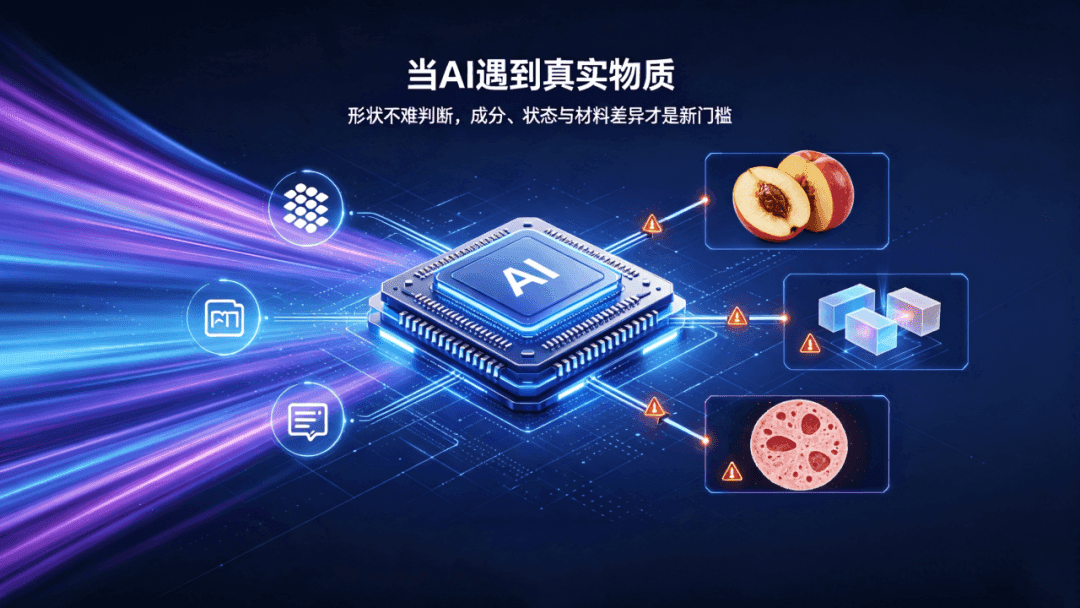
AI can beat Go champions, generate realistic images, and understand natural language, and it is moving into cars, factories, and robots. But if the same system is asked to judge whether a piece of fruit has internal browning, tell apart two pieces of plastic that look alike, or identify whether a tissue sample is abnormal, it may still struggle.
The problem often lies not in the algorithm but in the input. Most machine vision today is still built on RGB images. RGB cameras record the intensity of the red, green, and blue channels, and AI then learns edges, textures, colors, and shapes from these pixels. It is good at answering “What is this?” but cannot tell “What is it made of?”, “What is its internal state?”, or “Has a chemical change occurred?”
Because these answers don't lie entirely in the shape, but in the laws of how matter and light interact.
Cameras do the seeing; hyperspectral imaging is beginning to help machines understand.
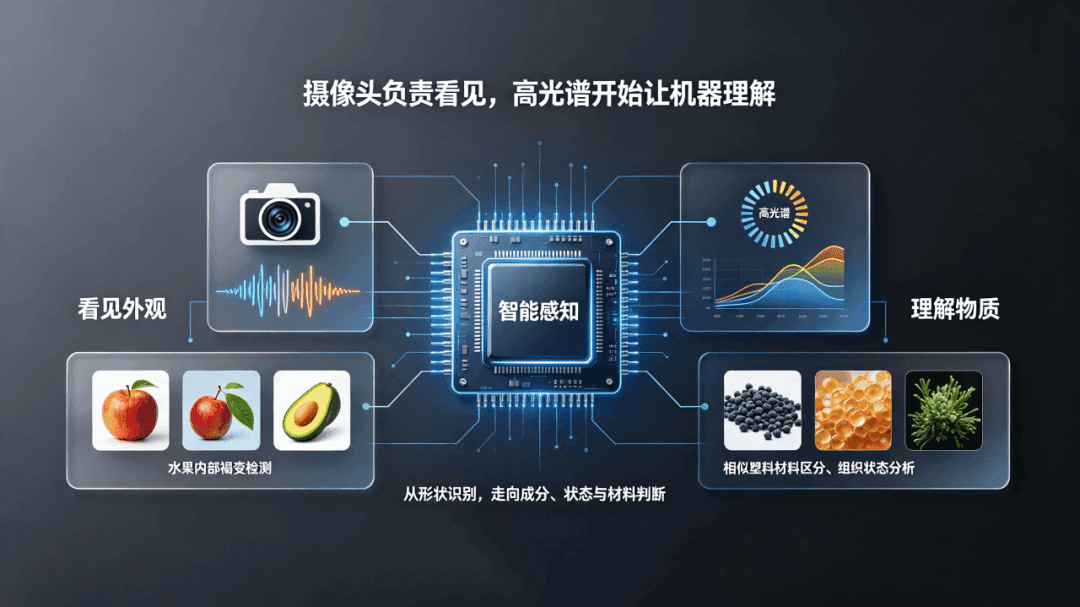
This is also a deeper change underway in the vision industry: competition once centered on higher resolution, higher frame rates, and better image quality; in the future, it will increasingly center on who can capture richer, more physically meaningful information. Vision is moving from “surface vision” toward “material vision.”
Why does AI need so much data?
Over the past decade, improvements in AI capabilities have often been accompanied by rapid growth in data volume. The reason is not complicated: when a single sample provides limited information, a model can only approximate the real world by observing a large number of samples from different angles, under different lighting, against different backgrounds, and in different states.
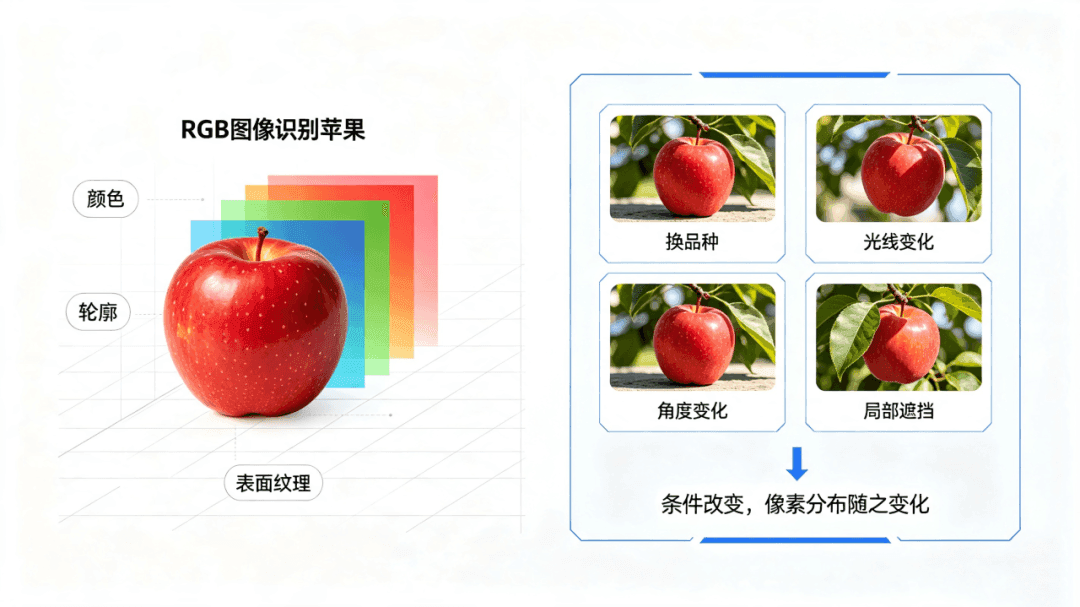
Take RGB image-based apple recognition as an example. The model sees color, contour, and surface texture. Change the variety, the lighting, the shooting angle, or partially occlude the apple, and the pixel distribution changes. To achieve stable recognition, the system needs to continuously add training samples to cover all variations as much as possible.
Therefore, the essence of many AI systems today is still statistical learning: a model is more likely to make the correct judgment the next time it encounters a similar appearance only after it has seen enough appearances. Data volumes keep growing not because AI inherently needs unlimited data, but because each RGB sample still carries limited physical information.
Hyperspectral imaging offers another path. It does not just add "more colors"; it lets a single pixel contain information from dozens to hundreds of contiguous wavelengths. Water, fat, protein, pigments, polymers, and mineral components can each produce relatively stable absorption or reflection features in the spectrum. This allows AI to use physical characteristics rather than relying only on appearance-based correlations.
AI capability ≈ data volume × information density per sample
In suitable material identification, composition analysis, and state detection tasks, higher information density is expected to reduce reliance on massive labeled datasets and improve model generalization and interpretability. The key shift is not that “all tasks no longer need big data,” but that each sample comes closer to the essence of the real world.
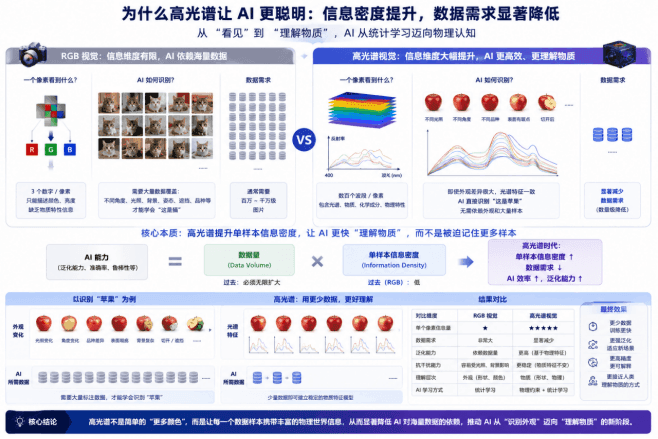
Figure 2 From massive appearance samples to high-information-density samples: hyperspectral imaging introduces material and physical information to AI
The visual industry as a whole is entering a "more colors" era.
The three RGB channels have defined digital vision for nearly two decades. From consumer electronics to industrial cameras, from security surveillance to autonomous driving, large-scale applications are built on the mature CMOS and RGB ecosystem. RGB thus became the infrastructure for the previous generation of general-purpose vision.
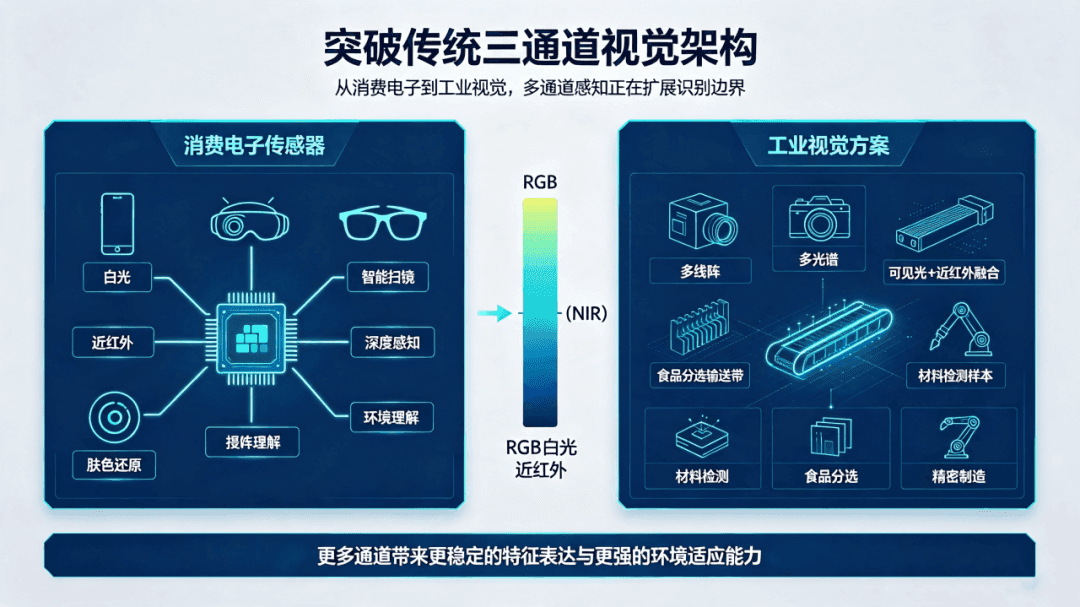
However, the industry has already begun to move beyond the traditional three-channel architecture. Consumer electronics sensors are gradually adding extra channels, such as white light and near-infrared, to improve low-light performance, depth sensing, skin tone reproduction, and environmental understanding. Industrial vision manufacturers were also early to offer multi-line-array, multispectral, and visible-light/near-infrared fusion solutions for material inspection, food sorting, and precision manufacturing.
These products are not necessarily all hyperspectral in the strict sense, but they point to the same trend: vision systems are moving from RGB to more spectral bands, and from imaging alone to capturing information that is more valuable for the task.
The competition in future vision systems may no longer be about who has more pixels, but about who can capture more valuable information.
Hyperspectral imaging did not emerge in isolation; it is the natural result of continually expanding the dimensions of visual information, from RGB to RGB+IR and on to multispectral and hyperspectral imaging.
What has hyperspectral actually changed?
1. From three colored pens to a continuous spectrum
Think of RGB as three colored pens: red, green, and blue. They are enough to reconstruct the familiar color world of human vision, but they cannot fully describe how a material responds at different wavelengths. Hyperspectral imaging, by contrast, is like tens to hundreds of colored pens arranged in a continuous sequence, each offering a new dimension for observation.
For the same apple, RGB primarily conveys its color and appearance; hyperspectral imaging can further reveal spectral changes associated with moisture, pigments, ripeness, and internal condition. For visually similar plastics, hyperspectral imaging can differentiate them based on polymer characteristics; for food, medicinal herbs, minerals, and tissue, it can provide compositional and state information that conventional vision has difficulty obtaining.
2. From recognizing images to understanding matter
The value of hyperspectral imaging is not in taking prettier pictures, but in moving vision from image space into material space. It gives machines a chance to answer a new set of questions: What material is this? What does it contain? What is its internal state? Has it deteriorated? Are there anomalies invisible to the naked eye?
In food and agriculture, it can be used for quality grading, ripeness analysis, and foreign-object detection; in industry, it can be used for material classification, coating uniformity, and process monitoring; in healthcare and life sciences, it can help identify tissue conditions and physiological changes; and in environmental and resource fields, it can identify contaminants, minerals, and vegetation conditions.
Hyperspectral imaging lets vision genuinely approach “material understanding” for the first time. This is also the most fundamental difference between it and ordinary color cameras and single-point spectrometers.
Why hasn't hyperspectral imaging become general-purpose vision after 40 years?
Hyperspectral imaging is not a new concept. It has long proven its capabilities in remote sensing, scientific research, military applications, and high-value industrial inspection, but it has remained confined to specialized equipment and specific use cases.
A common explanation is that the optical components are expensive, the detectors are complex, or the system is difficult to miniaturize. These factors do exist, but the deeper bottleneck is that the system must handle the massive amount of data generated by both the spatial and spectral dimensions. Compared with RGB, hyperspectral imaging may have tens or even hundreds of times more channels per frame, and the burden of acquisition, conversion, transmission, storage, and inference rises rapidly as a result.
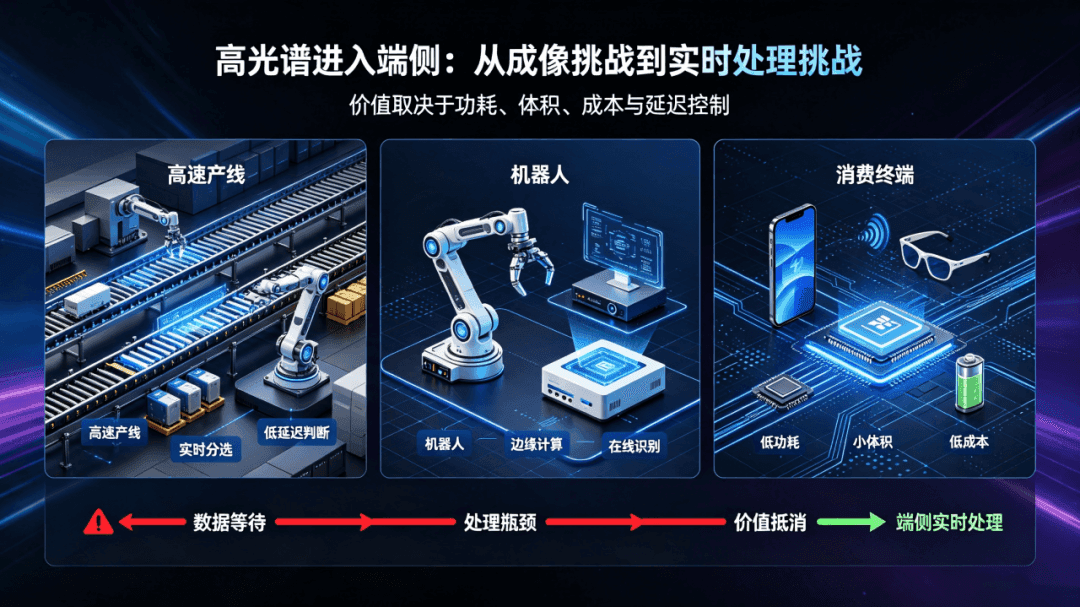
When these systems are deployed on high-speed production lines, in robots, or in consumer devices, the challenge is no longer simply whether they can capture images, but whether they can process them in real time within limited power, size, and cost constraints. Data latency at any stage can negate the value that hyperspectral imaging delivers.
The real bottleneck preventing hyperspectral imaging from entering general-purpose vision is not sensing capability itself, but computation and data movement.
Thus, the history of hyperspectral industrialization is also a history of computing architectures moving ever closer to the sensing end.
Evolution of hyperspectral computing architectures
01 Backend computation: hyperspectral is first and foremost an “instrument”
Early systems typically captured data with a camera, then sent it through an interface to a back-end workstation or server for offline analysis. This model suited research and low-speed inspection and proved that hyperspectral imaging “could work,” but bulky equipment, higher transmission latency, and complex algorithm pipelines made it difficult to deploy in real-time industrial settings.
02 Edge intelligence: from instruments to industrial equipment
As FPGAs, embedded GPUs, NPUs, and edge computing platforms mature, data acquisition and inference are beginning to run on the same device. Systems no longer need to upload all raw data to a remote location; instead, they perform feature extraction, classification, and control on site, directly driving gas valves, robotic arms, or production-line decisions.
The value of this stage is engineering: hyperspectral imaging moves from laboratory instruments to industrial equipment that can be delivered. Algorithms also increasingly incorporate optical principles, materials knowledge, and scene priors to improve stability and reduce labeling costs.
03 Optoelectronic integration and sensing-computing collaboration: reducing unnecessary data movement
Traditional systems typically go through several stages: optical signal acquisition, optoelectronic conversion, analog-to-digital conversion, data transmission, storage readout, and digital computing. As the dimensionality of information grows, the main energy challenge for the system gradually shifts from “how much energy one computation takes” to “how many times data is moved.”
The core of sensing–compute collaboration is not simply packaging multiple chips together. It is about performing filtering, encoding, or feature processing early at the sensing end, sending only genuinely useful information to downstream computation, and reducing bandwidth, power consumption, and latency at the system level.
04 Photonic sensing and computing integration: exploring future-oriented architectures
The starting point of hyperspectral acquisition is light itself. If, in the future, some sensing, encoding, and computing can be performed directly in the optical domain, there is an opportunity to reduce repeated optical-to-electrical conversions and data movement, and to use the parallelism of light to process multi-wavelength information.
Emerging architectures such as photonic computing, analog computing, compute-in-memory, and heterogeneous integration are all exploring the same core question: how to process information more efficiently where it is generated. In hyperspectral applications, the truly meaningful endpoint is not simply having a single faster compute chip, but enabling sensing, computing, storage, and communication to form a unified system.
This remains an emerging direction that will require long-term engineering validation. The article does not assume a single device path, but it can identify one trend: future computing architectures will center on reducing data movement and enabling deeper integration of sensing and computing.
05 Industry significance of the four stages
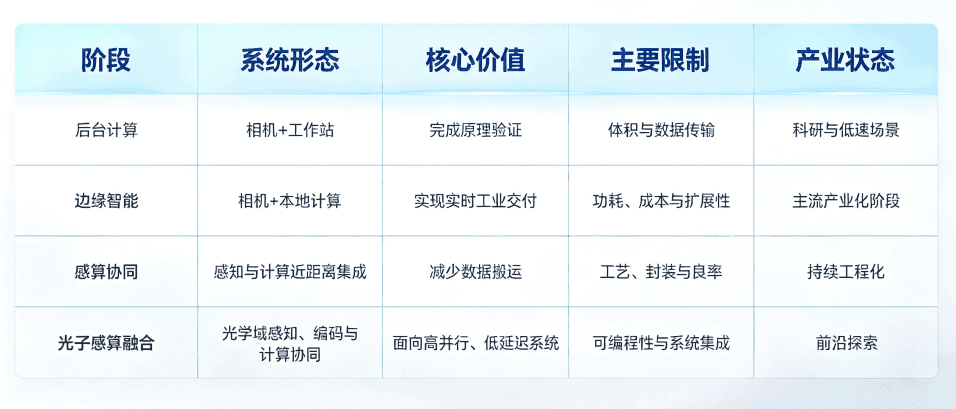
From “specialized vision” to “general perception”
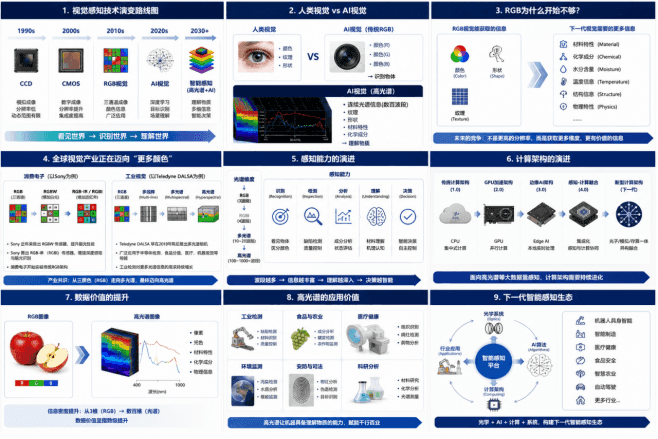
Figure 3 From general RGB vision and specialized hyperspectral vision to a future general intelligent perception platform
RGB became the universal vision solution not because it understands every material, but because it simultaneously delivers low cost, small size, low power consumption, standardization, and adequate usability. Hyperspectral imaging remains mainly used for specialized inspection today because systems must strike a balance between a higher information dimension and practical engineering constraints.
If photonic sensing, advanced devices, edge intelligence, and sensing-computing integration continue to reduce the cost, size, power consumption, and latency of hyperspectral systems in the future, the role of hyperspectral imaging will change fundamentally: it will no longer be only specialized inspection equipment in laboratories or on production lines, but may become a ubiquitous sensing component, much like today's RGB cameras.
Today: RGB is general-purpose vision; hyperspectral is specialized vision.
Future: Hyperspectral sensing is expected to become a general-purpose intelligent sensing device.
By then, vision systems will not only recognize people, vehicles, roads, and objects but also understand materials, conditions, composition, and risk. Applications will extend from a few high-value inspection scenarios to broader areas such as consumer electronics, robotics, autonomous driving, smart manufacturing, precision agriculture, food safety, healthcare, smart cities, energy and mining, environmental protection, aerospace, and defense and security.
Future industry opportunities: which industries will change first?
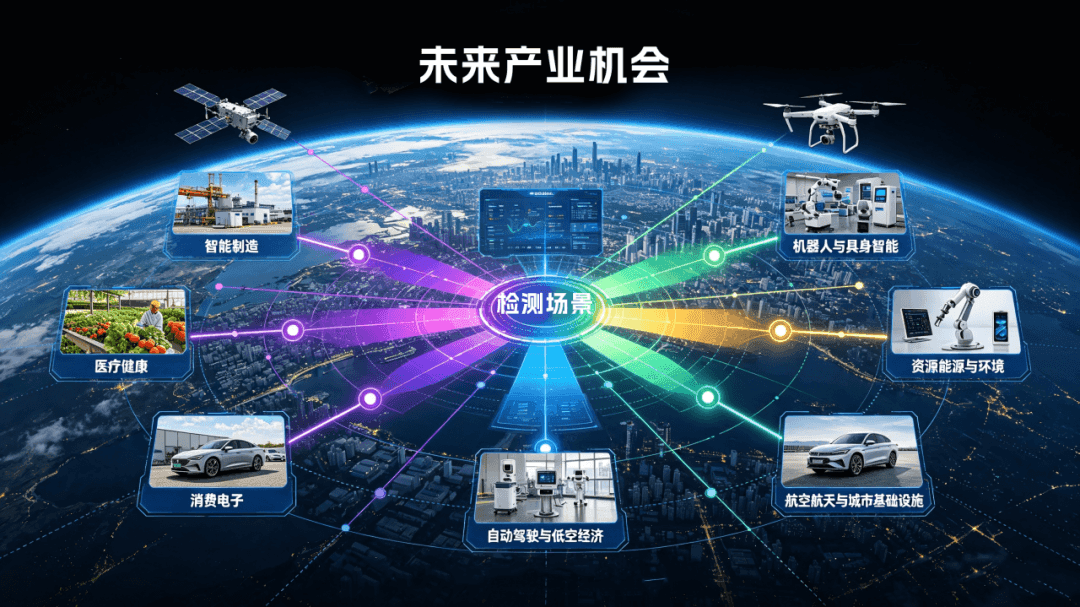
Smart manufacturing:From detecting surface defects to identifying materials, coatings, compositions, and process states, enabling earlier and more continuous quality control.
Food and agriculture:From manual spot checks and offline lab tests to inline sensing of sugar content, moisture, freshness, mold, protein, and ripeness.
Robotics and embodied intelligence:Enable robots to go beyond recognizing object shapes and also assess materials, liquids, contamination, food condition, and environmental risks.
Healthcare: provides new noninvasive or adjunctive dimensions of information for tissue status, blood oxygen, perfusion, skin, and minimally invasive diagnosis and treatment.
Consumer electronics:When components are small enough, low-power, and low-cost, phones, wearables, and smart home devices may gain substance and health sensing capabilities.
Autonomous driving and the low-altitude economy:Beyond conventional geometric vision, it adds the ability to recognize terrain, materials, weather, pollution, and hazardous substances.
Resources, energy, and environment:Used for mineral identification, sorting for recycling, water and soil monitoring, leak detection, and ecological status analysis.
Aerospace and urban infrastructure:Bring high-dimensional perception to satellites, drones, urban inspection, and public safety to build a more continuous spatial information network.
This does not mean that every scenario will use the full hundreds of spectral bands. Generalization is more likely to take the form of “acquiring the most valuable bands and features for the task”: the system can dynamically select sensing dimensions based on the scenario, striking an optimal balance between cost and information.
SPECU: toward a next-generation intelligent sensing platform
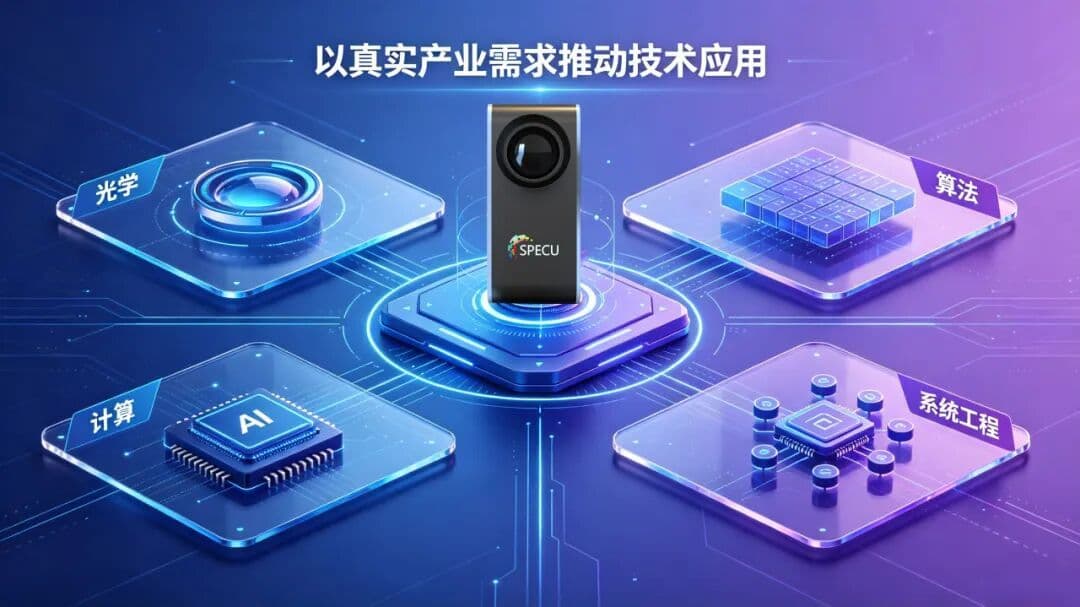
Amid this trend, SPECU has long followed the evolution of visual perception technology, maintaining sustained R&D investment in optics, algorithms, computing, and systems engineering, while using real industry needs to drive technology into application.
The company's focus is not limited to a single device or a single industry, but rather on how to bring richer spectral information into real-world systems at lower cost, lower power consumption, and higher efficiency, and to create verifiable value in applications such as food, agriculture, industry, healthcare, and robotics.
Looking ahead, SPECU hopes to help next-generation vision systems move from “seeing the world” to “understanding the world” and to contribute to building the intelligent sensing infrastructure of the photonic era. Specific device solutions and R&D roadmaps are part of the company’s core technology plans and are not discussed in this article.
Conclusion: next-generation AI needs next-generation perception
In the 1990s, the internet let people see faraway places;
In the 2010s, deep learning taught machines to recognize objects;
In the 2020s, large models enabled machines to begin understanding language.
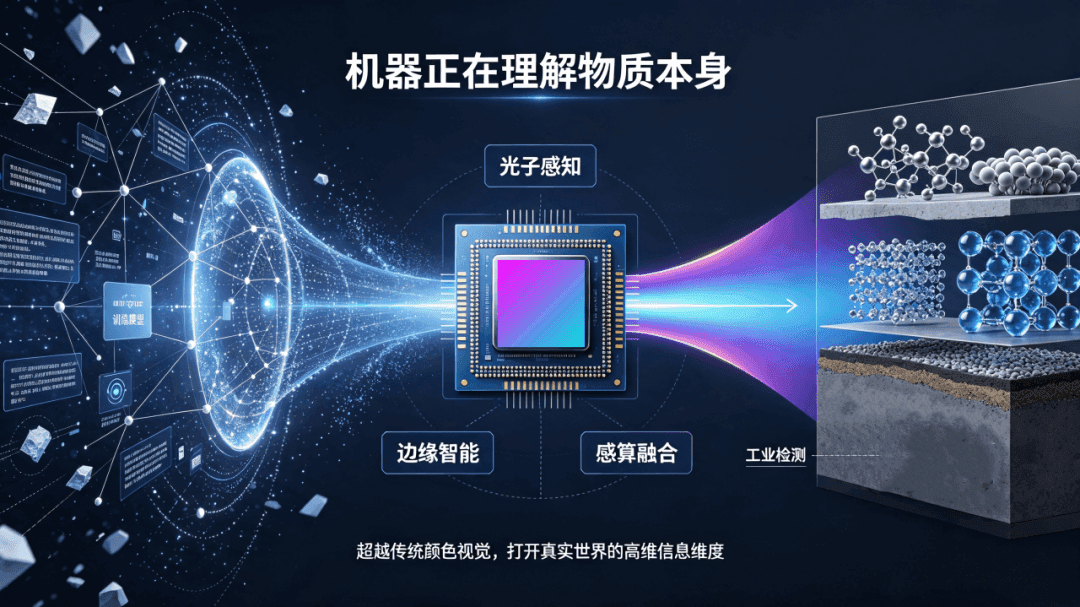
Yet the real world has long lacked one key dimension: making machines understand matter itself.
Hyperspectral sensing gives machines an information dimension beyond traditional color vision, while photonic sensing, edge intelligence, and sensing-computing integration are expected to address the system bottlenecks that high-dimensional perception faces as it moves toward widespread adoption.
Over the past three decades, machines have gained “eyes.”
Over the next thirty years, machines will gradually gain the ability to understand the physical world.
From digital vision (Digital Vision) to material vision (Material Vision) and on to intelligent sensing (Intelligent Sensing), vision technology is redefining how AI acquires information. In the future, hyperspectral sensing will no longer be merely a specialized inspection technology; it is expected to become the next generation of general-purpose intelligent sensing infrastructure.
Note: This article discusses industry trends and technology pathways. Statements about future performance, the pace of industrialization, and application scope are forward-looking judgments; actual progress will still depend on devices, process technology, algorithms, cost, and ecosystem maturity.