


In piles of pistachios mixed with broken shells and impurities, a hyperspectral lens can not only penetrate the shells to “read” the plumpness of the kernels and their risk of mold, but also accurately distinguish shells, whole kernels and fine impurities, enabling millisecond-level sorting. Cereal grains may show no visible mold spots, yet their spectral curves have already revealed early signs of mold — this is the magic of hyperspectral technology, which enables machines to move from “seeing images” to“analyzing composition and identifying categories,”reshaping how we perceive the world and process materials efficiently.
Core value
Unlocking the molecular-level key to the "visual blind spot"
Hyperspectral imaging (HSI) is an advanced imaging method whose core breakthrough is a three-dimensional data capability that unifies images and spectra: it can record across an ultra-wide wavelength range from visible to near-infrared, split electromagnetic waves into hundreds of narrow bands at the nanometer scale using devices such as gratings (and even capture thousands of spectral bands), provide continuous spectral data for each pixel, and construct a "data cube".
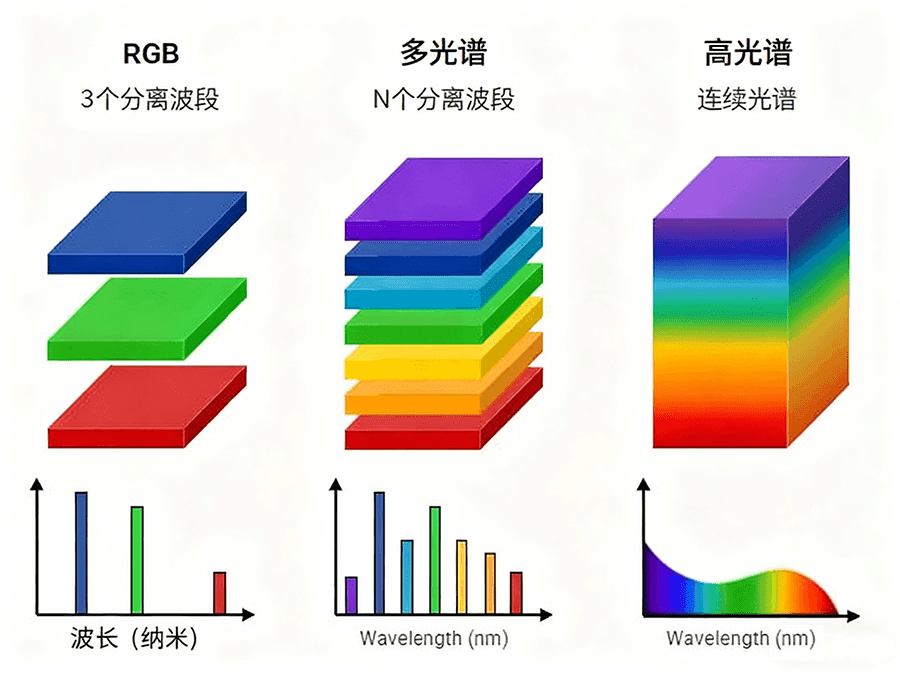
Conventional RGB imaging records only three primary-color spectral bands and has limited ability to distinguish materials. HSI, with more bands and high spectral resolution, can directly identify chemical composition and microscopic features, detect subtle changes in material properties, and truly make the leap from “visual observation” to “composition analysis and category identification.”
This advantage delivers two core values:
Early warning and precise classificationIt captures subtle changes invisible to the naked eye, such as molecular anomalies in the early stages of food spoilage or early signs of crop pests and diseases, while also quickly distinguishing between material types, such as pistachio shells, kernels, and foreign matter;
Non-destructive analysis and composition quantification, enabling accurate determination of substance composition and content without destroying the sample, with analysis and quantification completed in real time.
Application breakthroughs
From the lab to the front lines of industry, covering scenarios across multiple fields
HSI technology has now achieved breakthrough deployment across multiple fields, making “precise detection” and “efficient sorting” a reality, with applications far beyond common perception:
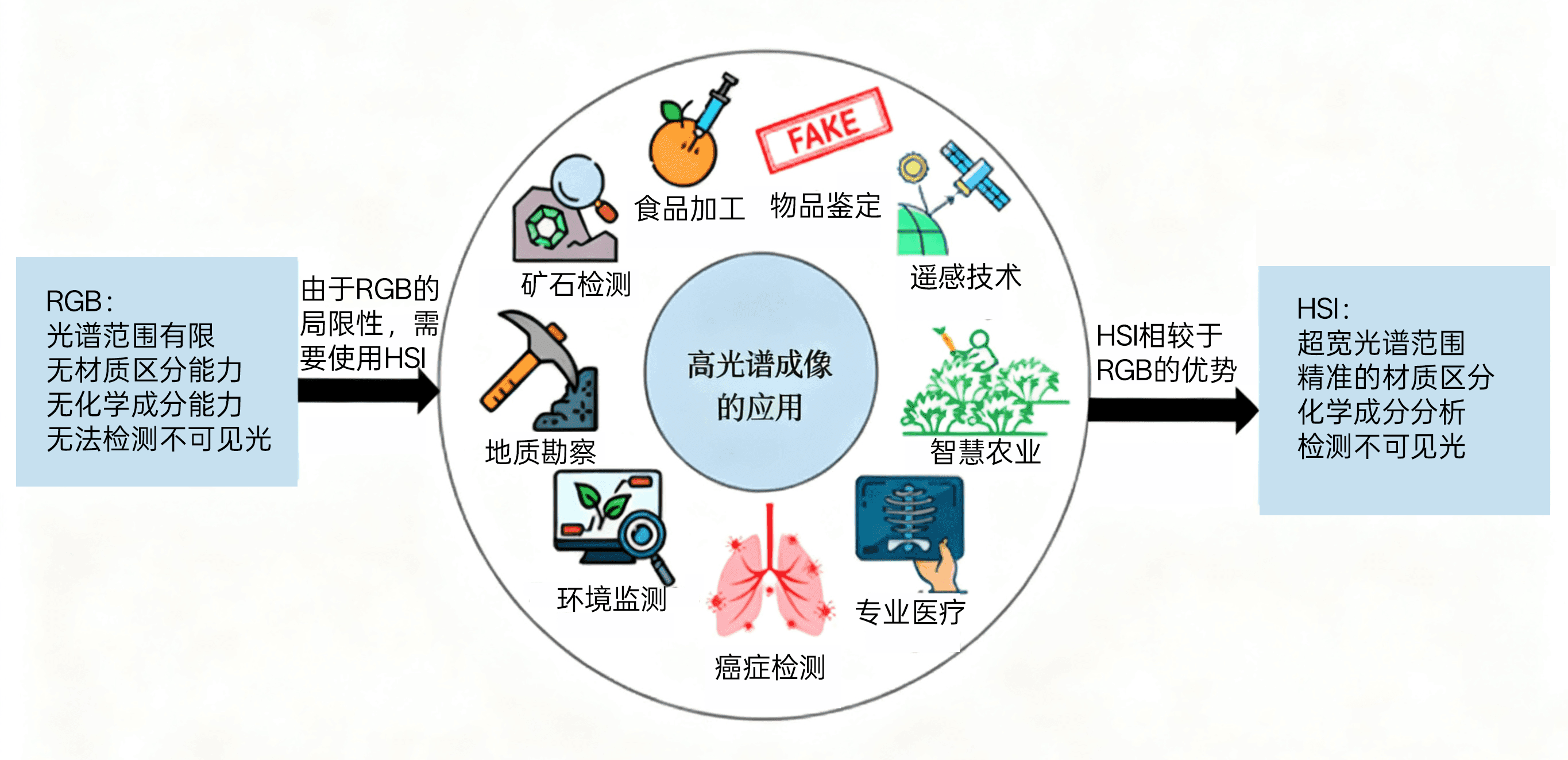
Food safetyIt overcomes the limitations of conventional inspection and accurately detects early mold inside grains and beneath the skin of fruits and vegetables, spotting hidden issues 1-3 days earlier than manual inspection. In nut sorting, it can quickly distinguish shells, kernels, and foreign matter for pistachios, almonds, and other nuts.
Smart agriculture:By analyzing crop spectral characteristics, it detects specific wavelengths associated with plant stress, nutrient deficiency, or disease, accurately assessing growth and nutrient status to support precise fertilization and significantly reduce agricultural losses.
Drug and counterfeit detection: It solves small-sample modeling challenges and rapidly identifies the active ingredient content of Western medicine tablets; because it is noninvasive, environmentally friendly, and nondestructive, it can analyze counterfeiting in solid pharmaceutical products and detect counterfeit goods.
Biomedical and specialty care: plays an important role in biomedical imaging, distinguishing healthy cells from diseased cells, supporting cancer detection, and providing technical support for early disease detection and treatment planning.
Geological exploration and environmental monitoring: In remote sensing and mining scenarios, minerals can be identified by their unique spectral signatures; in environmental monitoring, it can identify pollutants in water bodies and assess the health of forest vegetation.
Metalworking inspection: Accurately identifies defects such as fine cracks on metal surfaces, oxide layer thickness, and uneven composition, enabling non-destructive testing without contacting the metal workpiece. It can also analyze the elemental composition and purity of metal materials, helping control quality precision during processing, avoid subsequent product failures caused by material defects, and significantly improve inspection efficiency and product pass rates in the metalworking industry.
Different types of hyperspectral imaging systems also adapt to different scenarios through distinct spectral data acquisition methods:
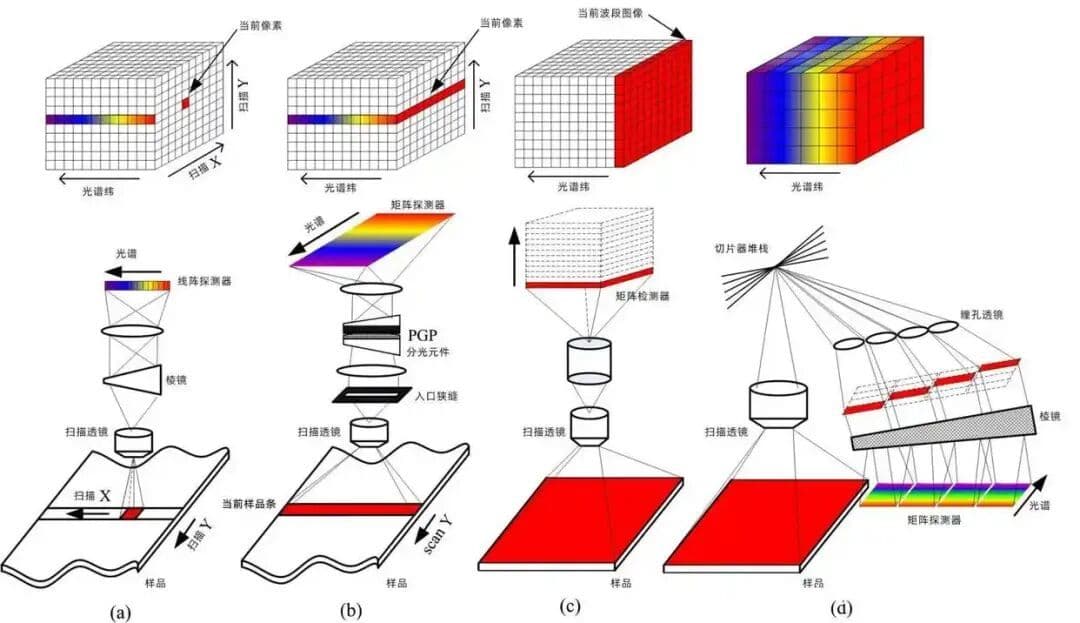
Point-scan camera: captures pixel by pixel by moving a single detector;
Line scan camera: records full rows of spatial data in sync as the image passes in front of the sensor; spectral scanning cameras use tunable filters to capture frames at a given wavelength and combine them into a complete dataset;
Spectral scanning camera:A single exposure captures a complete image in one spectral band. The core imaging setup consists of a tunable filter and a grayscale camera. By changing the filter's center wavelength and acquiring images band by band, then stitching them together, it ultimately forms a hyperspectral data cube containing spatial and spectral information. It is suitable for static scene inspection that requires high spectral resolution.
Snapshot camera: as a recent technology, it captures a single hyperspectral frame and greatly reduces acquisition time.
Today, advances in sensor technology and data processing algorithms, combined with the integration of deep learning, have significantly improved the speed, resolution, and accuracy of hyperspectral imaging systems, further expanding the scope of their applications.
SPECU: hyperspectral technology for needs in every scenario
Developed in-house by SPECU, the RobustVision K2000 hyperspectral camera uses chip-level optimization to capture mold features at the "molecular level" and an optical design that enables millimeter-level lesion identification. It efficiently identifies subtle spectral information, significantly improving detection efficiency across multiple scenarios.
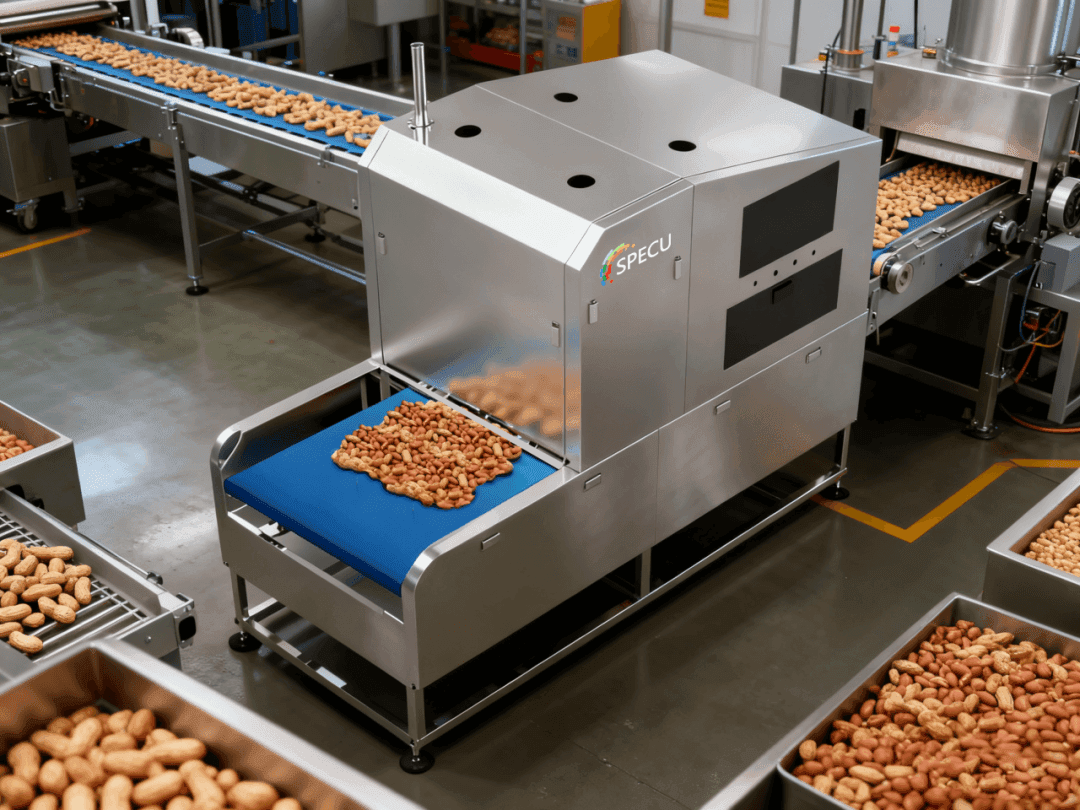
Customer success stories
The tracked hyperspectral intelligent equipment achieves a sorting accuracy of ≥99% and supports inspection and sorting in multiple scenarios, including grains, fruits and vegetables, meat, nuts, and metalworking quality inspection. It enables a seamless end-to-end “identify–decide–execute” workflow. SPECU is extending hyperspectral technology from laboratory-grade applications into healthcare, industrial, and other fields, truly giving machines the ability to “read” the world and classify materials efficiently.
The future of hyperspectral imaging is one where every inspection is accurate and efficient, every sorting task is fast and precise, and every application is safe and controllable. SPECU is at the forefront of this innovation.