

As agricultural modernization advances, hyperspectral technology has become a key technical support for improving crop quality and efficiency, thanks to its core advantage of “non-destructive, precise monitoring” and its ability to capture subtle growth signals without contacting the crops.
In agriculturally advanced regions overseas, Europe and the United States have deeply integrated hyperspectral technology into cultivation:
① In major U.S. corn-producing areas, drones equipped with hyperspectral equipment collect chlorophyll and moisture data without contact to optimize irrigation and fertilization, increasing corn yield per mu by 12%–15% and nitrogen fertilizer use efficiency by 20%, while reducing resource waste and environmental pollution;
② In Dutch greenhouses, fixed hyperspectral systems detect cellular-level disease signals in roses and tomatoes 1–2 weeks in advance, keeping the loss rate below 5% (versus 30% for traditional visual inspection);
③ In desert date palm cultivation, Israel uses hyperspectral data to derive soil and crop water requirements, saving 300 cubic meters per hectare while maintaining a fruit set rate above 90%, addressing agricultural water scarcity in arid regions.
The transition of traditional agriculture toward precision and efficiency
The in-depth application of hyperspectral technology in agriculture is driving the transition of traditional agriculture toward greater precision and efficiency. In China, agricultural applications of hyperspectral technology have entered a phase of large-scale deployment and are closely aligned with the country's agricultural production needs, for example:
Yield forecast for rice-growing areas in Heilongjiang:Researchers installed fixed spectral camera monitoring systems to track rice growth in real time. Combining this with other data, they built a growth model and predicted yield at the heading stage, with error kept within 5%.
Xinjiang cotton smart management: hyperspectral and thermal infrared dual-mode imaging is used to build chlorophyll distribution maps during flowering and water demand models during boll development, achieving 30% water savings and a 15% yield increase.
Intelligent monitoring of wheat stripe rust: China's first "wheat stripe rust intelligent monitoring and early warning system" accurately identifies the disease using a spectral database, achieving over 90% accuracy, reducing early warning response time by 60%, and increasing disease prevention and control efficiency by more than 40%.
Precision fertilization for soybeans: agricultural technicians scan the soil with a ground-based spectral camera and build a quantitative model linking soil nutrient content to spectral characteristics. This enables precision fertilization and increases soybean yield by about 15%.
Cherry quality inspection in Yantai, Shandong: spectral cameras are used for non-destructive testing of cherries, which are then picked and sold by sweetness, ripeness, and other categories, increasing growers' income by about 20%.
These practices show that hyperspectral technology can effectively address pain points in China's agriculture, such as blind fertilization, delayed disease detection, and difficult quality control, providing technical support for ensuring food security.
Advantages of hyperspectral imaging in agriculture
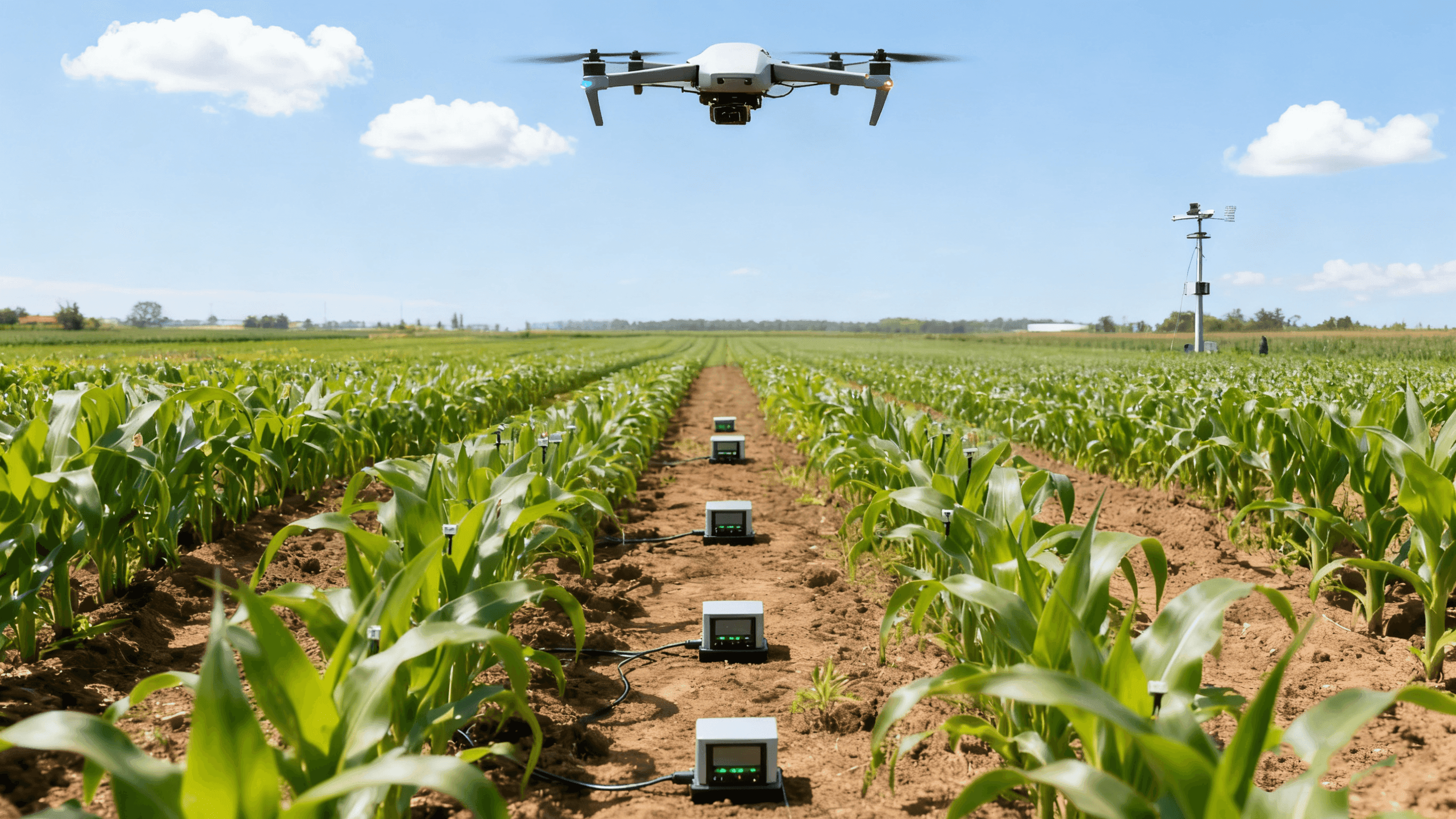
1. Precise monitoring, early warning
Identifies early crop stress:Spectral data captures subtle physiological changes caused by pests and disease, water shortage, or nutrient deficiency.
More monitoring dimensions:Distinguish disease types and identify which nutrient is deficient in a single step, providing a basis for targeted control and fertilization.
2. Improve efficiency and reduce costs
Replacing traditional manual sampling:Manual field inspections are inefficient, while hyperspectral equipment can quickly cover large areas of farmland and provide more objective data.
Reduce resource waste:Based on accurate monitoring of crop growth and stress, pesticides and fertilizers can be applied as needed, avoiding unnecessary inputs.
3. Improve quality and ensure safety
Non-destructive crop quality testing:No need to pick the fruit; spectral analysis can quickly measure internal quality indicators such as sugar content, acidity, and vitamin levels.
Supporting agricultural traceability and safety:Spectral signatures can be used to distinguish growing regions and varieties, and can also help detect safety hazards such as pesticide residues in agricultural products.
Comparing hyperspectral market trends in China and abroad
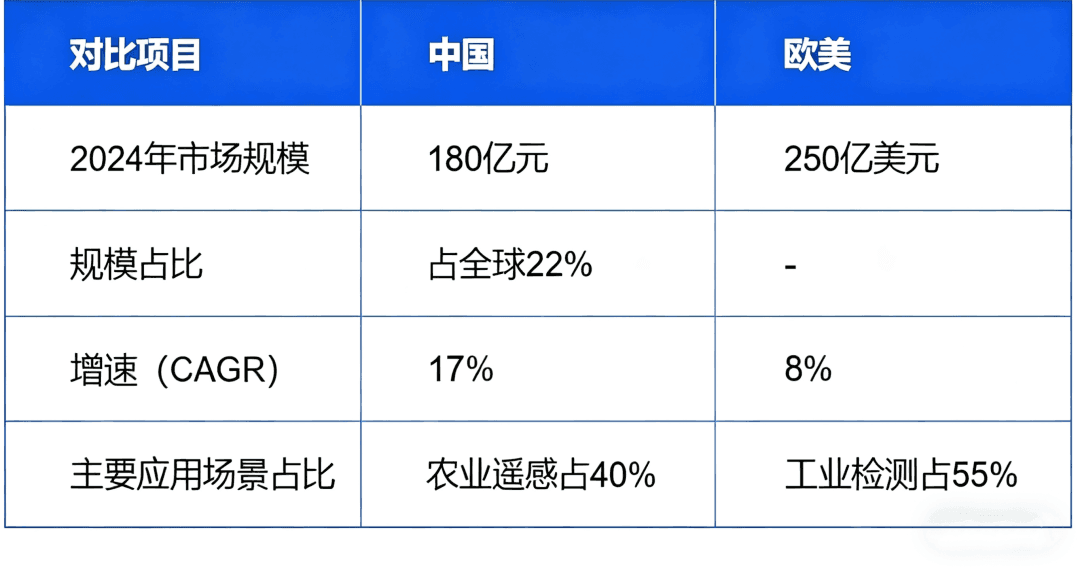
In the global hyperspectral imaging market, China and the European and American markets show a distinct pattern: a gap in scale but an advantage in growth rate.
In terms of market size, the European and U.S. markets remained significantly larger than China's in 2024, but China's market shows stronger growth momentum, with a compound annual growth rate notably higher than that of Europe and the U.S.
Differences in application scenarios reflect the distinctive needs of each regional market: as a major agricultural country, China has a strong need for farmland monitoring, which has made agricultural remote sensing a core application area for hyperspectral technology, accounting for 40% of overall applications. Typical examples include precision agriculture scenarios such as early monitoring of wheat stripe rust using drones equipped with hyperspectral devices. In Europe and North America, by contrast, a developed industrial base means the technology is more often used for industrial inspection to meet product quality control and production process monitoring needs.
Hyperspectral technology expands across fields; SPECU achieves innovation breakthroughs
As the technology matures and costs fall, hyperspectral technology is accelerating its expansion from scientific research and agriculture into other fields. Through technological innovation, SPECU empowers industrial upgrading while also helping the country achieve self-reliance and control over core technologies.
SPECU is a company built on joint Chinese–UK research capabilities.Its independently developed hyperspectral camera has achieved three major breakthroughs through a full-stack architecture developed entirely in-house:
① Equipped with a custom hyperspectral chip, it captures “molecular-level” signals characteristic of materials, eliminating the “visual blind spots” of conventional detection;
② Achieve millimeter-level target recognition through optical-mechanical co-design, covering an ultra-wide spectral band;
③ Better able to give early warning of hidden issues and avoid risks at the source.
Looking ahead, in core technology autonomy, SPECU's hyperspectral technology will build a full-chain self-reliant ecosystem spanning chip design, manufacturing, and system integration, ending reliance on foreign high-end components. At the industrial upgrading level, the technology will extend into strategic emerging fields such as new energy, high-end manufacturing (e.g., purity analysis of semiconductor materials), and biomedicine (e.g., spectral imaging of cell metabolism), helping China's industries transition from "manufacturing" to "intelligent manufacturing."