
Food and agriculture
Blueberries
Blueberry internal mold detection and sorting

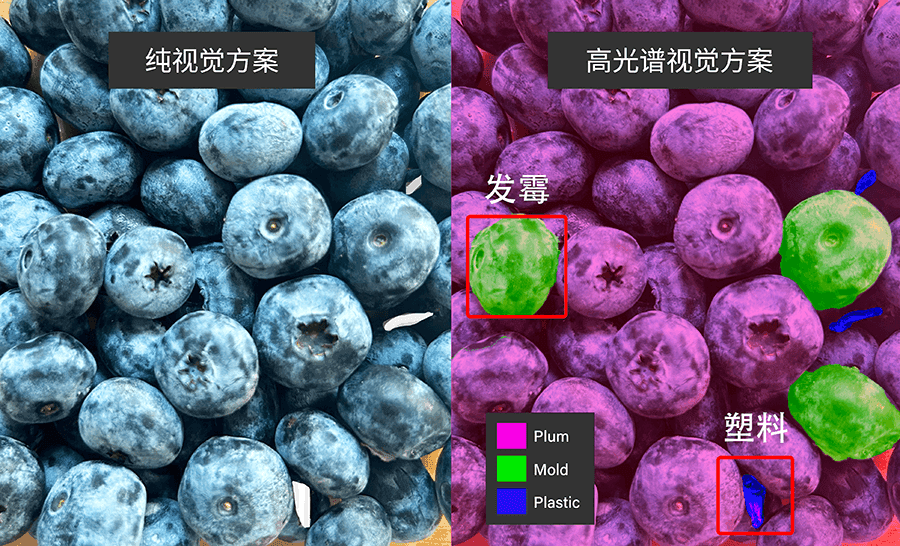
- Hyperspectral nondestructive inspection: no cutting or piercing required. Using in-house hyperspectral imaging, it inspects blueberries without damaging the whole fruit. It sees through the skin to accurately identify internal mold and hidden decay, screening out all bad berries that look intact outside but are moldy inside, eliminating missed detections in manual visual inspection.
- Distinguishes surface bloom from internal mold with high accuracy. It accurately distinguishes the spectral signatures of natural blueberry bloom from internal mold, so high-quality berries with bloom are not mistakenly rejected. Detection rates for mold, browning, and hollow decay are stable, reducing losses from mistakenly removing good fruit.
- High-speed inline integration for volume processing. Supports continuous post-harvest sorting on the line and can connect to integrated washing, air-drying, and grading lines. No manual re-inspection is required, greatly improving processing throughput. Suitable for small and medium processors through large cold-chain enterprises.
- Stable 24-hour operation, resistant to water droplets on the fruit surface. The equipment's algorithm handles wet berries with water droplets, so inspection can proceed after washing without thorough drying. Industrial-grade hardware supports continuous round-the-clock sorting with a low failure rate and simple maintenance.
- Compatible with all blueberry types and flexibly adjustable for multiple sizes. Handles large, medium, and small berries, as well as bulk and boxed blueberries, with one-touch parameter switching. It can also sort cracked, soft, and insect-damaged berries at the same time, enabling one machine to screen for multiple defects simultaneously.
- Data-driven traceability and quality tracking. Sorting data is stored in real time, and the number of moldy berries and share of bad fruit are automatically counted. Quality reports are generated to meet traceability audit standards for supermarket and export orders.

Reduce material loss and minimize financial losses.
Intercept fruit with hidden internal mold, prevent batch mold-related spoilage and scrapping after finished products enter distribution, substantially reduce losses from warehousing, logistics, and supermarket returns, and significantly increase the premium potential of fresh fruit.
2. Raise product grade to capture the high-end market
Blueberries with no internal mold and zero hidden defective berries can be supplied to premium supermarkets, e-commerce gift-box channels, and export channels, moving the product away from low-end bulk price competition and raising both selling prices and brand competitiveness.
3. Replace substantial manual labor and reduce staffing costs
It eliminates the manual steps of visually checking every piece and cutting open samples for inspection. One production line can run with 3–6 fewer sorting workers, substantially reducing labor wages and management costs over the long term and easing hiring difficulties for fruit and vegetable processors.
4. Consistent supply quality that builds a reputation for long-term cooperation
Standardized sorting and grading ensure consistent blueberry quality in every batch, reduce buyer complaints, and help secure long-term orders from supermarkets, fresh food chains, and major foreign trade clients.
5. Compliant exports, opening up overseas channels
Internal moldy defective fruit is strictly removed, meeting domestic and international fresh-produce food safety testing standards, avoiding the risk of customs inspection seizures due to mold, and opening up broader cross-border export channels.
6. Digital management to optimize improvements in cultivation and processing
Mold data can be fed back to growing bases to identify batches with high mold incidence and their causes, helping farmers adjust harvesting, storage, and transport practices to reduce internal mold problems in blueberries at the source.